Food noise: an equal opportunity menace
This boring chart should change how you think about GLP-1s.



Who should take a GLP-1? Everyone has an answer, and it’s almost always based on how someone looks. To some, using a GLP-1 is still seen as cheating. To others, it’s fine, as long as they view you as someone who “really needs it.” Either way, the underlying judgment remains: We’re still letting body size dictate who we think deserves treatment.
But weight loss is only one part of the story. GLP-1s might also turn down the volume on food noise.
Food noise isn’t regular hunger or the occasional sweet tooth craving rearing its ugly head. It’s the persistent, often quite intrusive thoughts about food that can be difficult to quiet or control. People with food noise may struggle to regulate their food intake, and the constant thoughts about food could be taking a toll on their daily life and emotional wellbeing.
Food noise is real, but until recently there wasn’t a good way to measure it. So Ro collaborated with a team of expert academics to develop a validated scale for food noise known as RAID-FN.
We took a look at some recent food noise data collected from Ro Body patients who filled out the scale before they started treatment. What we found should give all the Who-Deserves-It-Ism pause: Food noise looked almost identical across the spectrum of patients with a body mass index (BMI) over 25.
Meaning, it’s just as often that someone seeking treatment at Ro with a BMI of 27 is struggling with food noise as much as someone with a BMI of 47.
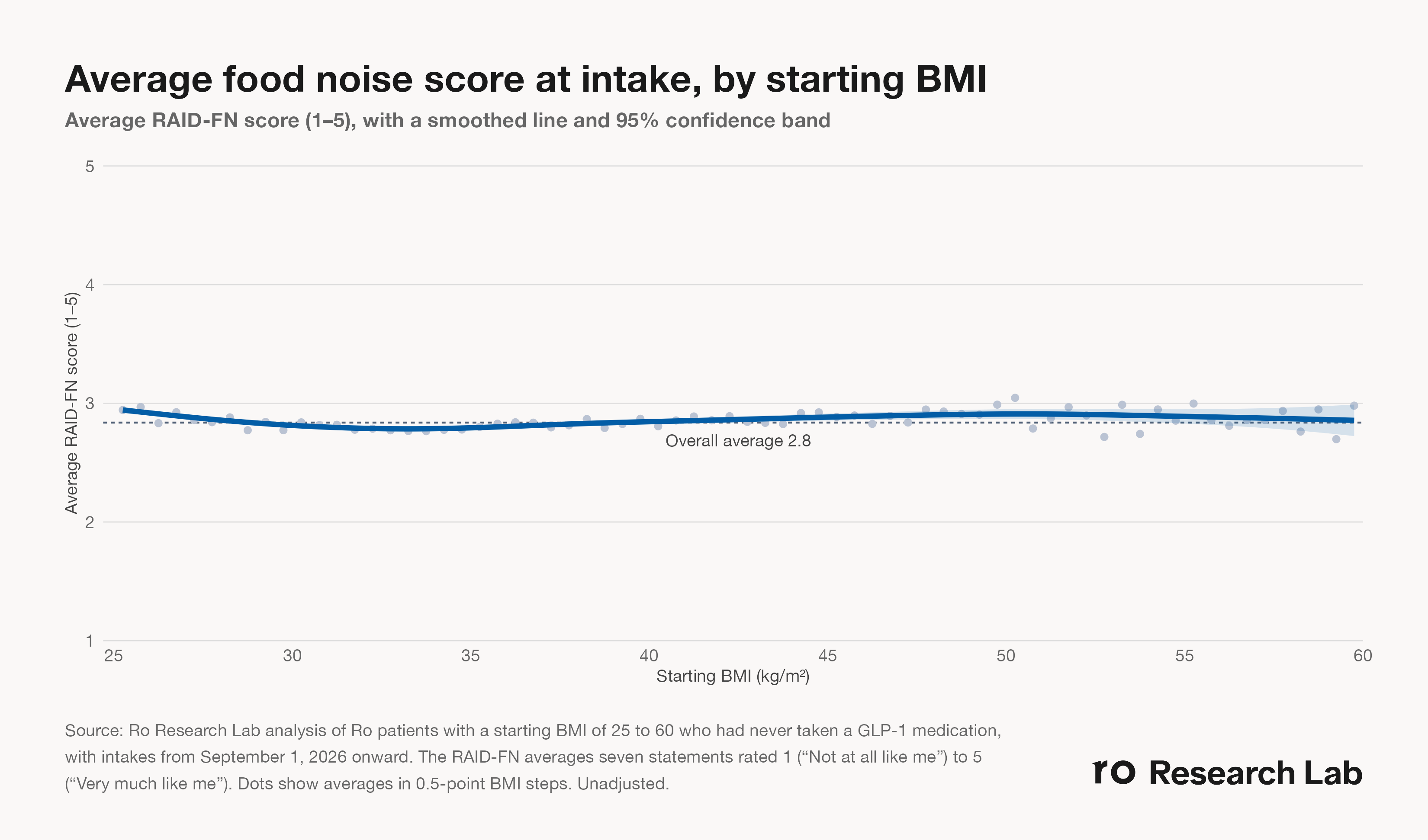
It’s not often that those in the research world look at a chart with a flat line and find it interesting. But in this case, it highlights that food noise is an equal-opportunity menace. And more importantly, you can’t tell who might need a GLP-1 just by looking at them. (Curious where your food noise falls? Find out with our free, short quiz built with the RAID-FN scale.)
The emotional distress of food noise
Let’s go a little deeper on one specific finding from the RAID-FN scale.
In addition to measuring an overall food noise score on a scale of 1 to 5, it also provides scores for different aspects of the food noise experience.
- Persistence: the frequency of unwanted food thoughts
- Preoccupation: the inability to dismiss those thoughts
- Dysphoria: the emotional burden that comes with the thoughts
The dysphoria component of food noise is based on two statements:
- “I hate that I always have food on my mind.”
- “I hate myself for not being able to control my thoughts about food.”
Patients are asked to rate how closely each statement reflects their experience on a 5-point scale, where 1 = Not at all like me, and 5 = Very much like me.
About half (51.9%) of our patients said the statement “I hate myself for not being able to control my thoughts about food” was at least somewhat like them. The chart below shows just how many patients are struggling with the painful, emotional side of food noise by starting BMI:
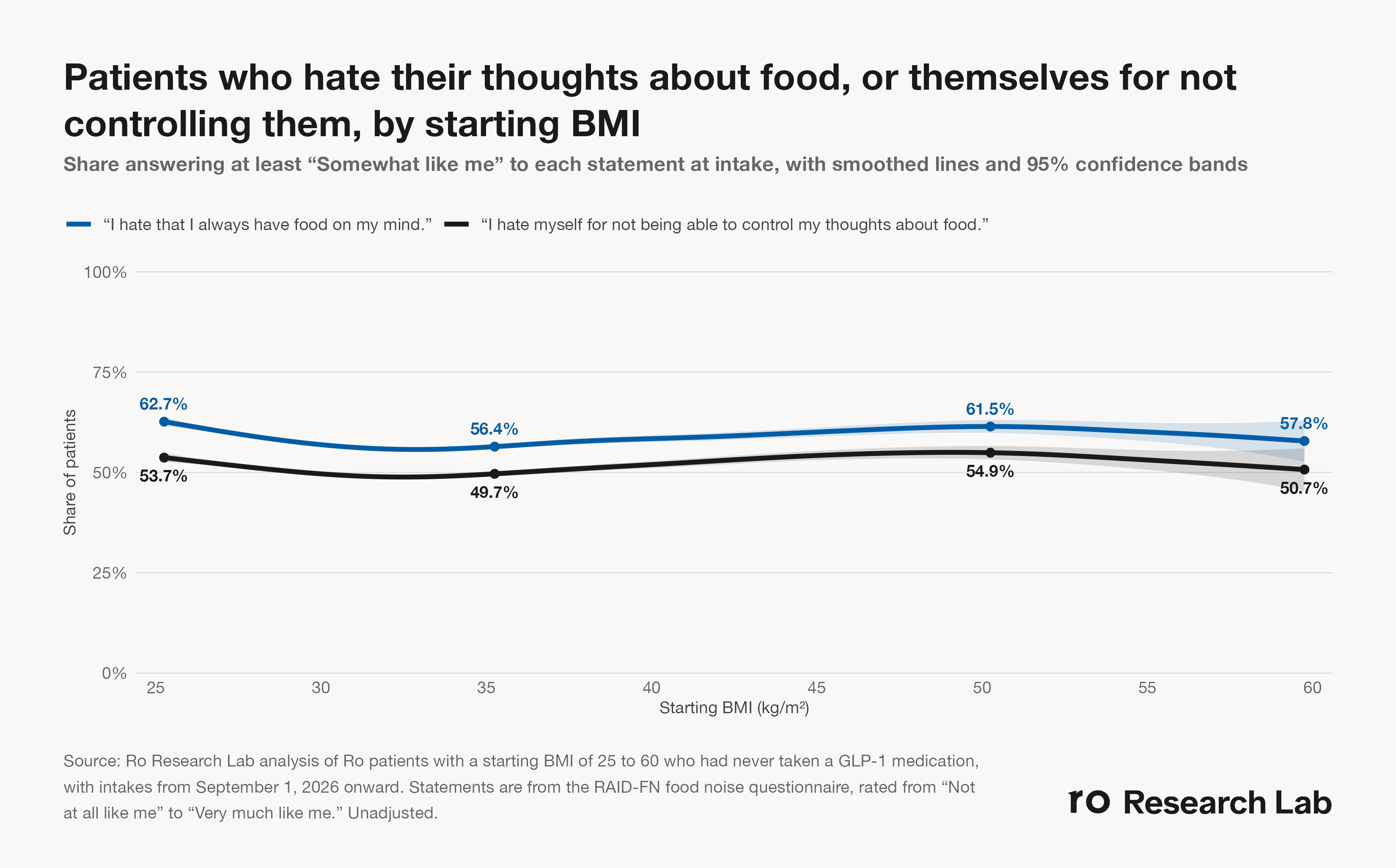
Like the overall food noise score, the percent of patients reporting they experience these feelings at least somewhat was relatively consistent across BMI values:
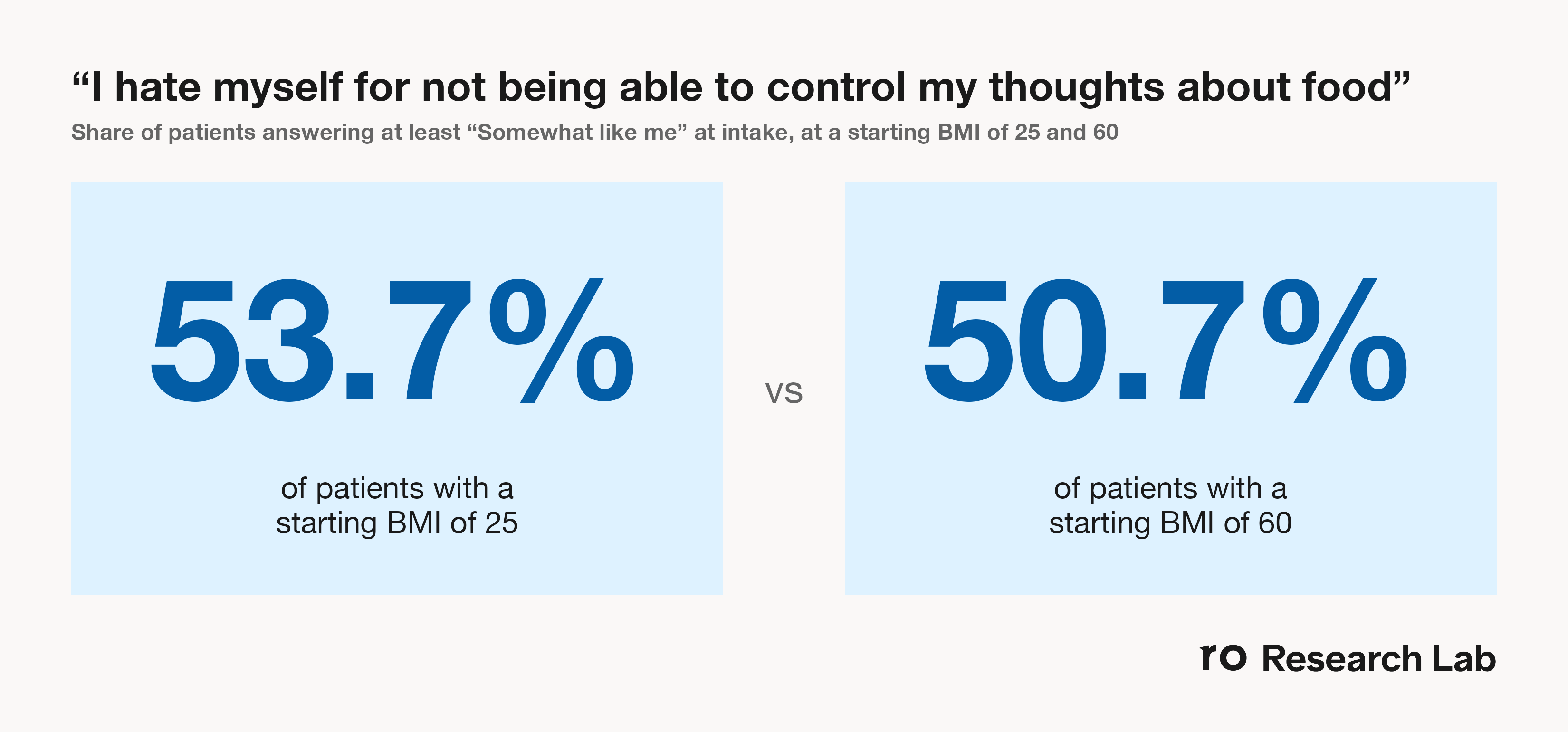
This highlights how someone’s body size tells you very little about the distress they may be experiencing because of their relationship with food.
Food noise doesn’t scale with body size. Neither should our assumptions.
In the next post of this series on food noise, we’ll be looking at what happens to patients’ food noise scores once they start GLP-1s. Spoiler: the chart takes a steep drop.
Methodology
We looked at RAID-FN responses among not-yet-treated Ro patients with a BMI of 25 or higher who had never taken a GLP-1 medication before. To calculate the food noise score, we averaged responses across the seven statements in the scale rated from 1 (“Not at all like me”) to 5 (“Very much like me”), with higher scores meaning more food noise. We compared average scores across starting BMI, from 25 to 60.
We also looked at the share of patients who answered at least “somewhat like me” to two statements: “I hate that I always have food on my mind” and “I hate myself for not being able to control my thoughts about food.” This analysis has some limitations. We did not adjust for other patient characteristics, such as age or sex, that could help explain the relationship between BMI, food noise, and how patients answered certain questions.
References
- 1.Arnaut, T., Duncan, S., Faurby, M., Hahn-Pedersen, J. H., Kvist, K., Steenackers, N., & Buse, J. B. (2026). Retrospective assessment of food noise changes after initiation of injectable semaglutide for weight management in the USA: The INFORM survey. Advances in Therapy, 43(8), 3649–3659. doi:10.1007/s12325-026-03636-x. Retrieved from https://link.springer.com/article/10.1007/s12325-026-03636-x
- 2.Dhurandhar, E. J., Maki, K. C., Dhurandhar, N. V., Kyle, T. K., Yurkow, S., Hawkins, M. A. W., Agley, J., Ho, E. H., Cheskin, L. J., Sørensen, T. I. A., Wang, X. R., Gorman, B., & Allison, D. B. (2026). Development and rigorous multistep validation of a psychometric tool to measure food noise. Appetite, 217, Article 108339. doi:10.1016/j.appet.2025.108339. Retrieved from https://www.sciencedirect.com/science/article/abs/pii/S0195666325004921