GLP-1 insurance coverage has fallen by half since 2024
More patients qualify than ever, but data suggests insurers continue to narrow who can afford them



GLP-1s keep earning new FDA approvals: heart attacks and strokes, sleep apnea, liver disease. Every new indication is the science saying, again and again, that these drugs improve peoples’ health.
Insurers appear to be hearing something else.
We examined outcomes of benefits checks and prior authorization (PA) submissions for hundreds of thousands of new, commercially insured, and clinically qualified Ro patients from January 2024 through October 2026. In 2024, 30% of patients who tried to use insurance had a confirmed pathway to coverage for Wegovy or Zepbound. In 2026, only 16% did.
Confirmed GLP-1 coverage for new patients who chose insurance
Share by week
How confirmed coverage is calculated
Confirmed coverage = ( new patients whose benefits check showed Wegovy or Zepbound covered without a prior authorization (PA) + new patients whose PA was approved ) ÷ all new patients, except those who needed a PA and chose to pay cash instead
Who’s left out: patients whose benefits check required a PA (or could not determine coverage) and who then chose a cash-pay option instead of using insurance. Patients excluded by their plan and patients covered without a PA stay in, since they had no PA decision to opt out of.
Example, 2026 (Jan–Sep): of every 100 new patients who chose insurance, 5 were covered without a PA and 10 had a PA approved: about 16 with confirmed coverage (figures rounded).
The other 84: excluded by their plan (55), PA required but denied, pending or never filed (15), coverage could not be determined (14).
Source: Ro Research Lab analysis of first benefits checks and prior authorizations (PAs) for Wegovy and Zepbound. Commercially insured, GLP-1-naive adults aged 18–63 without type 2 diabetes (BMI 30+, or 27+ with a weight-related condition); government plans excluded. Confirmed coverage = at least one medication covered without a PA, or the first PA (filed within 30 days) approved. Trailing 4-week rolling average, January 2024–September 2026.
These aren’t edge cases. Every person in this data met the medical criteria for a GLP-1, based on the FDA label and established standards of care. They qualified, but most didn’t get coverage approved.
The three ways insurance gets to “no”
Coverage didn’t shrink because of one closed door, but instead because several doors were narrowing all at once.
- The hard no of plan exclusions. In 2026, 43 of every 100 new patients had a plan that excluded both Wegovy and Zepbound. Exclusions rose after CVS Caremark dropped Zepbound from its standard formularies in July 2025, and again when plans reset in January 2026.
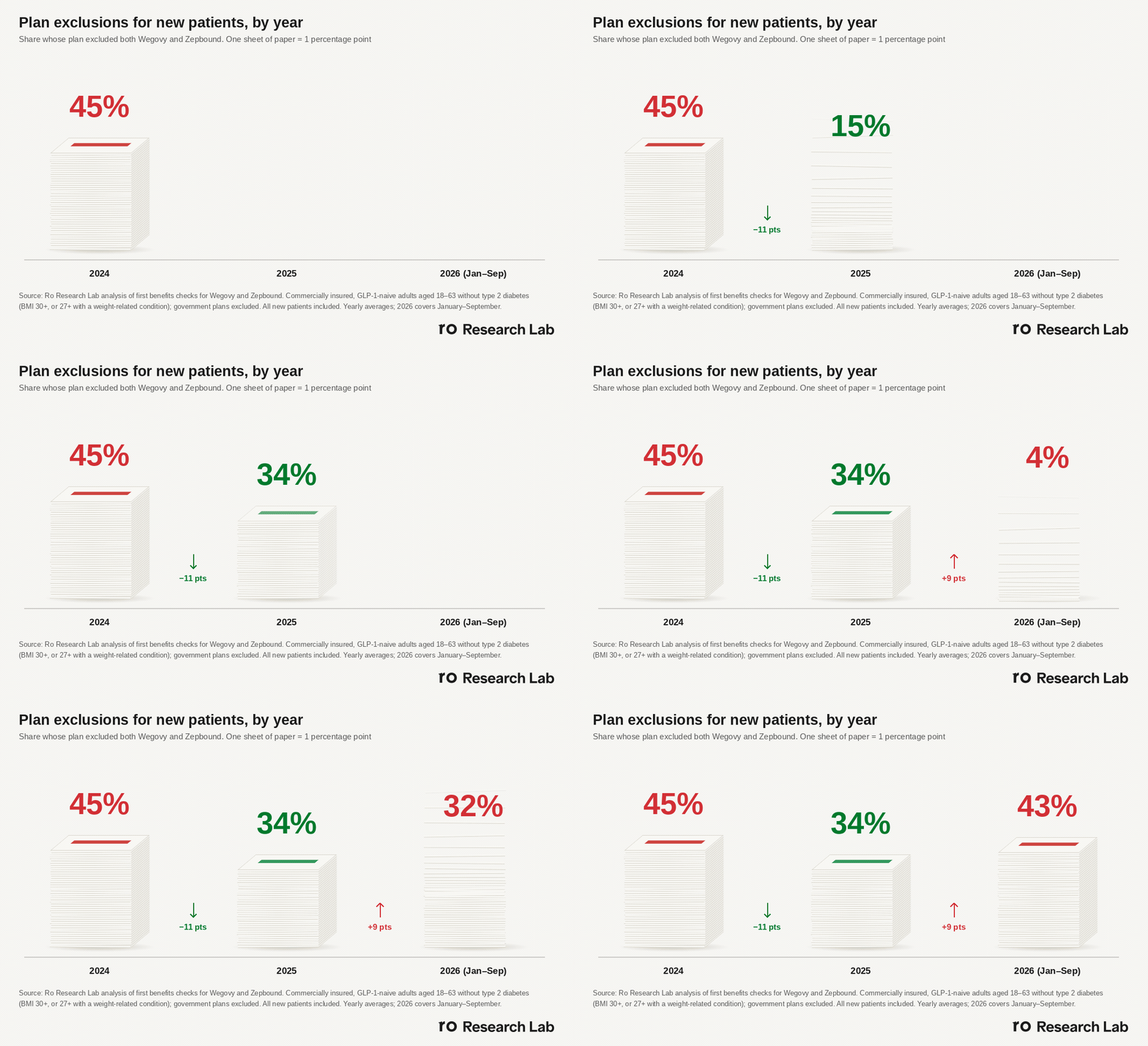
- Benefits purgatory. Plan exclusions dipped in 2025, but don’t celebrate yet — it’s not because more plans said “yes.” More benefits checks came back without a clear answer: Coverage couldn’t be determined for about 1 in 4 new patients in 2025 and 2026, up from 7% in 2024.
- The shrinking “yes.” Fewer patients had a prior authorization route at all: 44% in 2024, down to 31% in 2026 (in part because more benefit checks came back without a clear answer). PAs that did get submitted were approved less often — about 8 in 10 in 2024 compared with about 7 in 10 in 2026. Together, these shifts cut the share of patients who chose insurance and got an approved PA from 25% to 10%.
And the easy “yes,” where the drug is covered with no paperwork? It happened for about 5% of patients, every single year, or 1 in 20.
Expanded label, decreased coverage
You might expect a growing list of approved uses to bring more coverage. More indications mean more patients with a clear-cut medical reason to be on the drug, and more evidence that it’s worth paying for.
Unfortunately, as new indications have rolled out, coverage has only continued to slide.
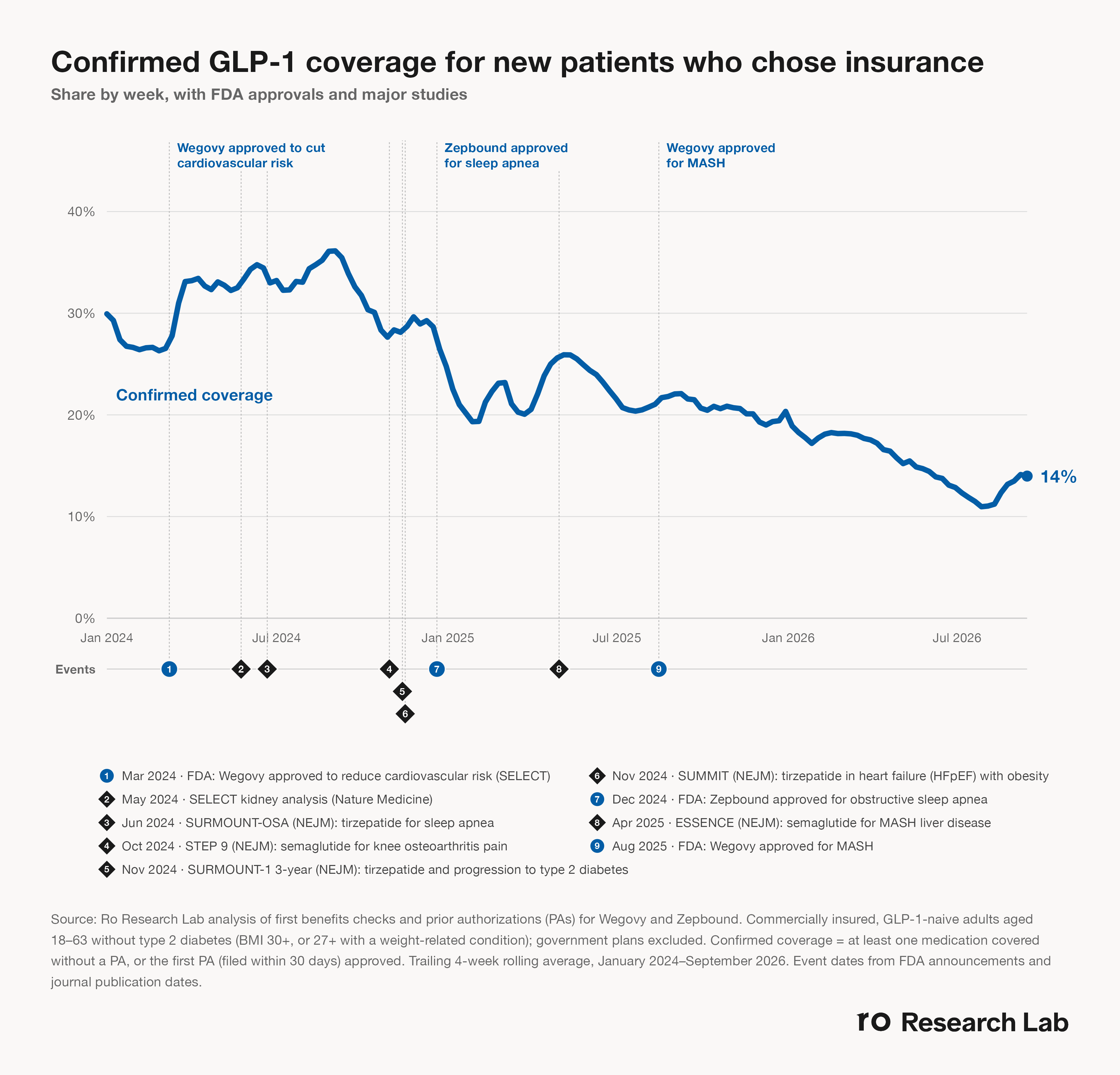
Coverage climbed through much of 2024, including the months after Wegovy was approved to reduce cardiovascular risk. Since then, the approvals kept coming: Zepbound for sleep apnea in December 2024 and Wegovy for metabolic dysfunction-associated steatohepatitis (MASH) in August 2025, with a string of major trials supporting these new use cases in between.
Over nearly three years, the science went one direction and coverage went the other.
Behind every coverage denial is a person trying to improve their health. When access depends more on insurance design than medical need, the system, as it exists today, is keeping patients from receiving care that could meaningfully improve their lives.
Methods
We analyzed first benefits verification results for Wegovy and Zepbound for new Ro patients from January 2024 through September 2026. All patients were commercially insured adults aged 18–63, new to GLP-1 medications, without type 2 diabetes, and met the FDA label’s weight criteria: a BMI of 30 or higher, or 27 or higher with a weight-related complication.
Plan exclusion rates include all patients, while confirmed coverage is defined as having at least one medication covered without a PA or receiving approval for the first PA submitted within 30 days. Patients who required a PA but opted to pay cash instead were excluded from the confirmed coverage measure. Results are presented as trailing four-week rolling averages and yearly averages.
Several limitations should be considered when interpreting these trends. Findings reflect Ro’s patient population and may not be generalizable to all insured adults. Benefits verification results represent a snapshot in time, and the growing proportion of checks with indeterminate coverage status is particularly important when interpreting changes in coverage rates. Additionally, confirmed coverage does not necessarily indicate that a prescription was filled or affordable, and the analysis captures only initial PA decisions, excluding subsequent approvals or appeals.