From pounds down to pound town…at least for men
Not even GLP-1s are free from the gender gap.


We’ll get straight to the point: When it comes to GLP-1s, women may be dropping more pounds, but men seem to be dropping more trou.
While it’s no secret that losing weight can improve your sex life, Ro’s patient data reveals something a little more surprising: Men taking GLP-1s were more likely than women to report a better sex life during treatment, even when they lost similar amounts of weight. And the gap generally widened as patients lost more weight.
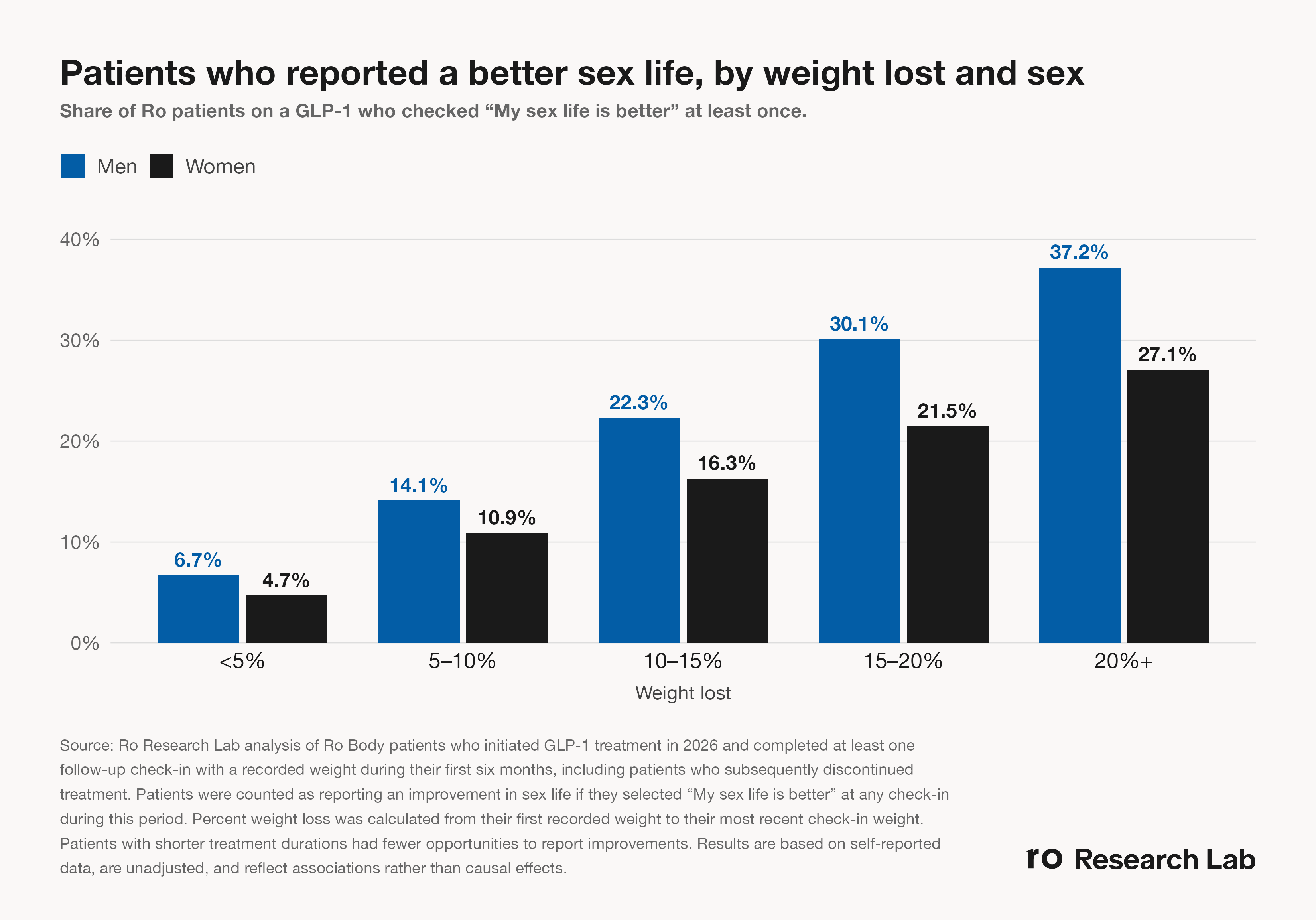
About once a month, we ask Ro Body patients how their GLP-1 is helping them. Out of a select-all-that-apply list ranging from better mood to more energy, men selected “My sex life is better” more frequently than women — so much more frequently that we had to dig deeper.
Among patients who lost less than 5% of their body weight, 6.7% of men reported a better sex life compared to 4.7% of women.
For those who lost 20% or more of their body weight, the split was more stark:
37.2%
of men who lost 20%+ of their body weight reported a better sex life
27.1%
of women who lost 20%+ of their body weight said the same
1.4×
how much more likely men were than women to report a boost at that level
Meaning, men in the top weight-loss bracket were about 40% more likely than women to report a boost in their sex lives. Same relative weight loss, but a different story between the sheets.
Now, if you’re thinking “Ah, a gender gap in the bedroom? Groundbreaking.” in your best Miranda Priestly deadpan, we get it. But with Reddit riddled with reports of GLP-1s killing libido, our findings were already intriguing — and the GLP-1 and sex gender gap only grew more interesting when we factored in age.
As men and women age, so does the bedroom gap on GLP-1s
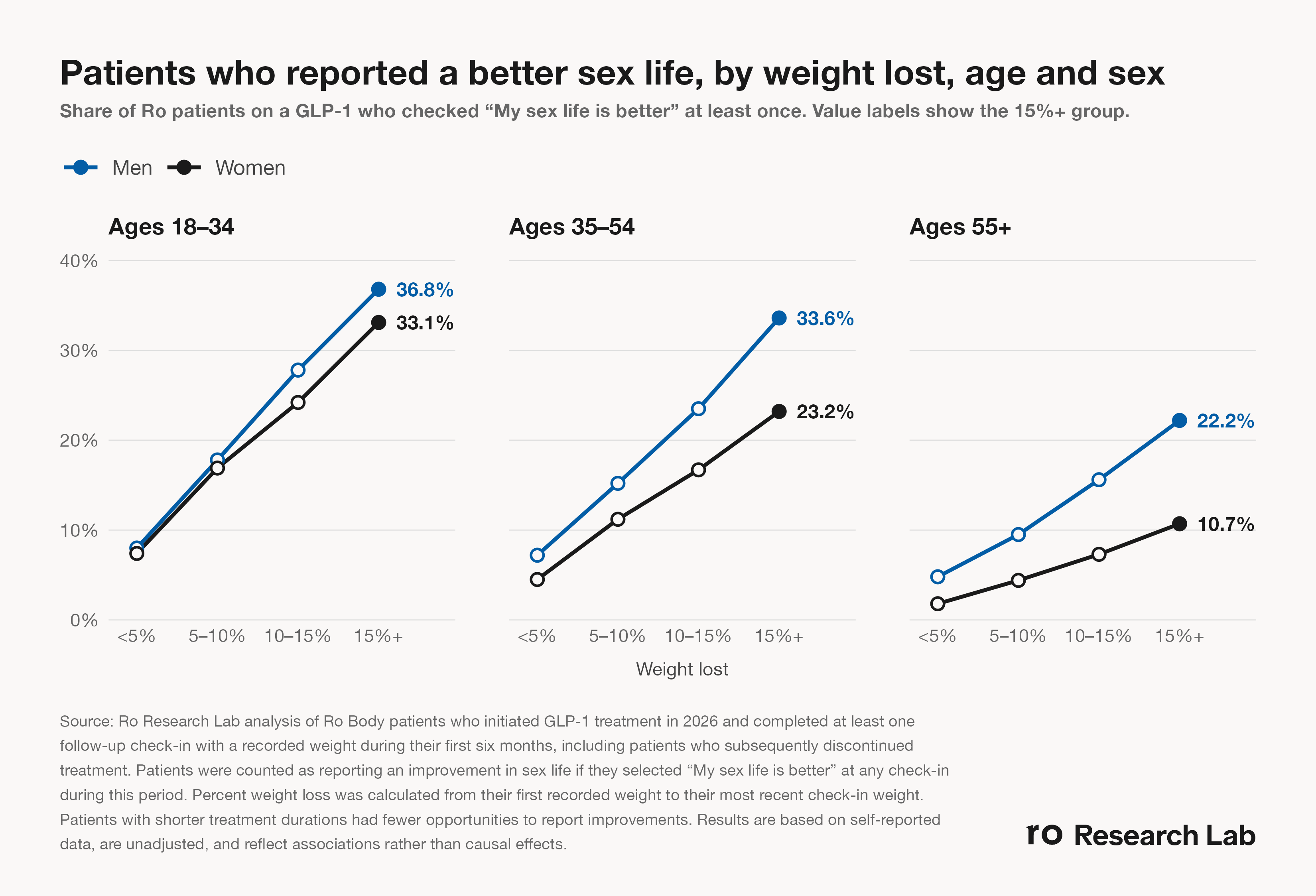
Apparently, age isn’t an equal-opportunity buzzkill when it comes to reported bedroom benefits.
For younger patients (18–34), there’s barely a gap: 36.8% of men and 33.1% of women reported a better sex life at least once.
But among patients 55 and older, men came out on top, with slightly more than double reporting a better sex life (22.2% vs. 10.7%).
While reports of a better sex life became less frequent with age for both men and women (and that’s not shocking given the science), the decline appeared steeper among women.
So, what’s behind the bedroom gap on GLP-1s?
Why might men on GLP-1s report more improved sex than women, and even more so as they get older?
Since we’re just recently discovering these doin’-it discrepancies, the answer is still, admittedly, TBD. But there are a few possibilities worth exploring.
- Testosterone levels are higher in men. Because obesity tends to suppress testosterone in men but can elevate it in women, GLP-1–associated weight loss may increase testosterone in men, potentially contributing to improvements in sexual function (since T levels and sex go hand in hand in men).
- Menopause may present a challenge in women. As women age, hormonal changes associated with menopause can affect sexual desire and function, potentially influencing how much of a boost they experience in the bedroom.
But for now, that’s all speculation. Our data show a relationship between weight loss on GLP-1s, age, and reported improvements in sex life — not why those differences exist. Plus, there’s a lack of evidence on the relationship between obesity, sexual desire, and GLP-1 therapies, with researchers hypothesizing that their effects on sexual desire may evolve over time.
What we do know is that patients are noticing changes during GLP-1 treatment that extend well beyond the scale. And as we continue exploring those benefits, you can bet we’re not afraid to get a little intimate with the data.
Stay tuned for more 👁️👄👁️.
Methodology
To examine how reported improvements in sex life varied by gender, age, and weight loss, we analyzed data from Ro Body patients who initiated GLP-1 treatment in 2026 and completed at least one follow-up check-in during their first six months of treatment. At each check-in, patients were asked, “How is the medication helping you?” (select all that apply).
We calculated the percentage of patients who selected “My sex life is better” at least once, comparing responses across gender, age, and weight loss groups. Weight loss was measured as the percent change from each patient’s first recorded weight to their weight at their most recent check-in and categorized as <5%, 5%–9.9%, 10%–14.9%, 15%–19.9%, or ≥20%.
Because improvements could be reported at any check-in, some patients may have reported a better sex life before achieving their most recently recorded weight loss. Patients with shorter treatment durations also had fewer opportunities to report improvements. All responses were self-reported, and results are unadjusted and reflect associations rather than causal effects.
References
- 1.Avis, N. E., Colvin, A., Karlamangla, A. S., Crawford, S., Hess, R., Waetjen, L. E., Brooks, M., Tepper, P. G., & Greendale, G. A. (2017). Change in sexual functioning over the menopausal transition: Results from the Study of Women’s Health Across the Nation. Menopause (New York, N.Y.), 24(4), 379–390. doi:10.1097/GME.0000000000000770. Retrieved from https://journals.lww.com/menopausejournal/abstract/10.1097/gme.0000000000000770~change-in-sexual-functioning-over-the-menopausal-transition
- 2.Biernikiewicz, M., Rusiecka, A., & Kałka, D. (2025). Obesity and sexual desire: A systematic review and meta-analysis. The Journal of Sexual Medicine, 22(5), 677–693. doi:10.1093/jsxmed/qdaf057. Retrieved from https://academic.oup.com/jsm/article-abstract/22/5/677/8101328
- 3.Eng, P. C., Phylactou, M., Qayum, A., Woods, C., Lee, H., Aziz, S., Moore, B., Miras, A. D., Comninos, A. N., Tan, T., Franks, S., Dhillo, W. S., & Abbara, A. (2024). Obesity-related hypogonadism in women. Endocrine Reviews, 45(2), 171–189. doi:10.1210/endrev/bnad027. Retrieved from https://academic.oup.com/edrv/article/45/2/171/7240177
- 4.Gelfand, S. T., Tveit, M. C., & Simon, J. A. (2025). Clinical review of how glucagon-like peptide-1 agonist obesity medications decrease sexual desire, and a biopsychosocial model for why we don’t ‘see’ it. Obesity Pillars, 17, 100233. doi:10.1016/j.obpill.2025.100233. Retrieved from https://www.sciencedirect.com/science/article/pii/S2667368125000774
- 5.Muir, C. A., Wittert, G. A., & Handelsman, D. J. (2025). Approach to the patient: Low testosterone concentrations in men with obesity. The Journal of Clinical Endocrinology and Metabolism, 110(9), e3125–e3130. doi:10.1210/clinem/dgaf137. Retrieved from https://academic.oup.com/jcem/article/110/9/e3125/8058933
- 6.Salvio, G., Ciarloni, A., Ambo, N., Bordoni, M., Perrone, M., Rossi, S., & Balercia, G. (2025). Effects of glucagon-like peptide 1 receptor agonists on testicular dysfunction: A systematic review and meta-analysis. Andrology, 13(8), 2022–2034. doi:10.1111/andr.70022. Retrieved from https://onlinelibrary.wiley.com/doi/10.1111/andr.70022