GLP-1s drop food noise-related self-hatred by half in just 3 months
“I hate myself for not being able to control my thoughts about food”: 50.4% before a GLP-1, 24.2% after.


There’s thinking about food. Then there’s thinking about food so much that you start to hate yourself for not being able to control it.
That’s the darker side of food noise, and as we recently found, it doesn’t discriminate by body size. Neither does the emotional toll. For many people, the constant, intrusive chatter about food comes with an equally relentless dose of self-criticism.
GLP-1s may be best known for helping people shed pounds. Our data suggest they may also help people shed something less visible (though arguably as heavy to carry): the mental baggage that comes with food noise.
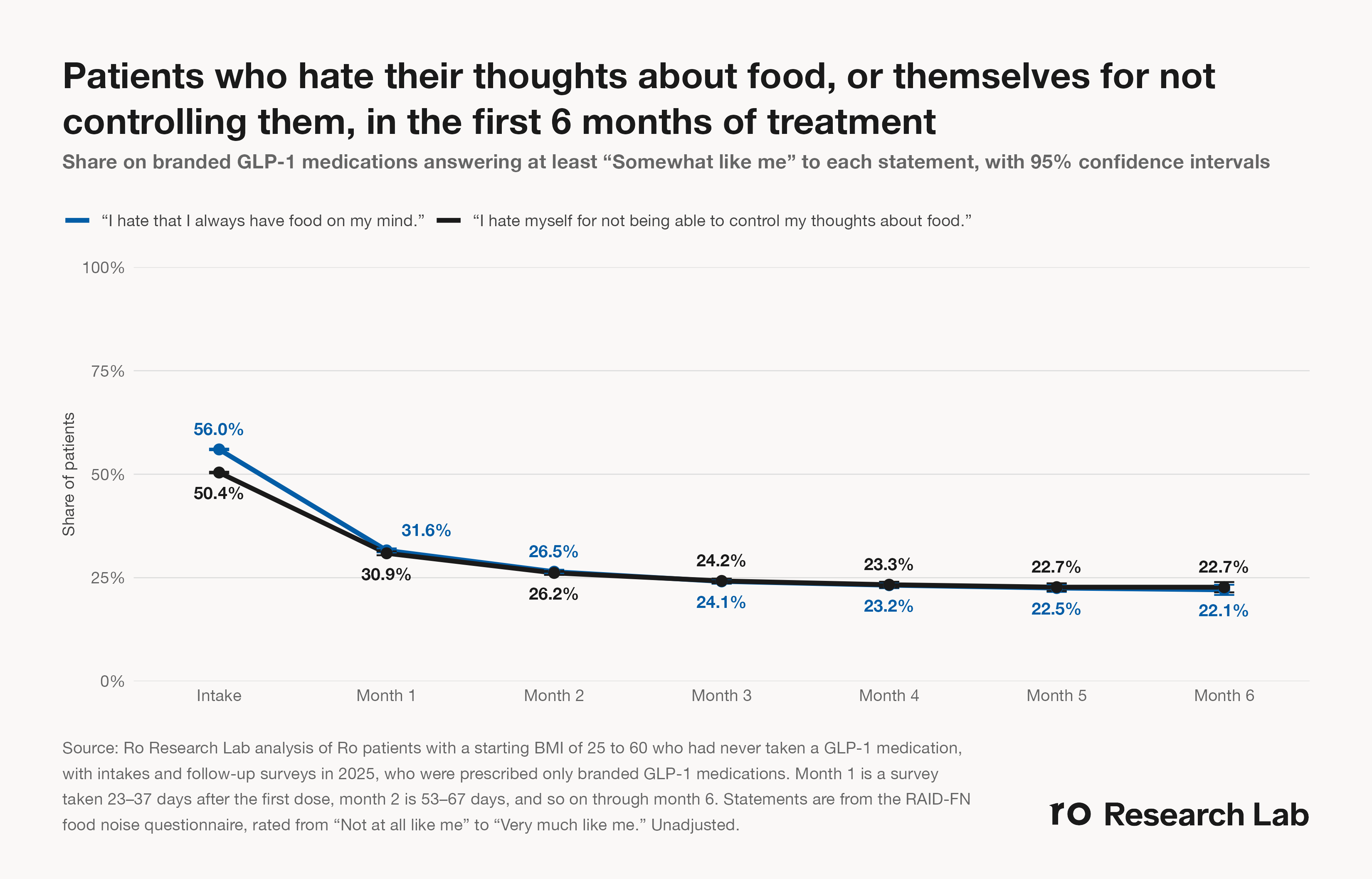
At the start of treatment (pre-medication):
- 56.0% of Ro Body patients reported some degree of hating that food was always on their minds.
- Roughly half (50.4%) reported some degree of hating themselves for not being able to control those thoughts.
Just three months later, the percentage of patients reporting these experiences dropped to around 24%.
That’s a 57.1% decrease in those who reported food noise-related frustration and a 52.4% decrease in those who reported associated self-criticism. In other words, after three months on a GLP-1, the share of patients reporting some degree of self-hatred drops by more than half. More. Than. Half.
To quote Emeril, “BAM!”
It’s worth noting that at three months of treatment, weight loss is just ramping up. But the alleviation of mental weight? That’s already kicked in — almost instantaneously.
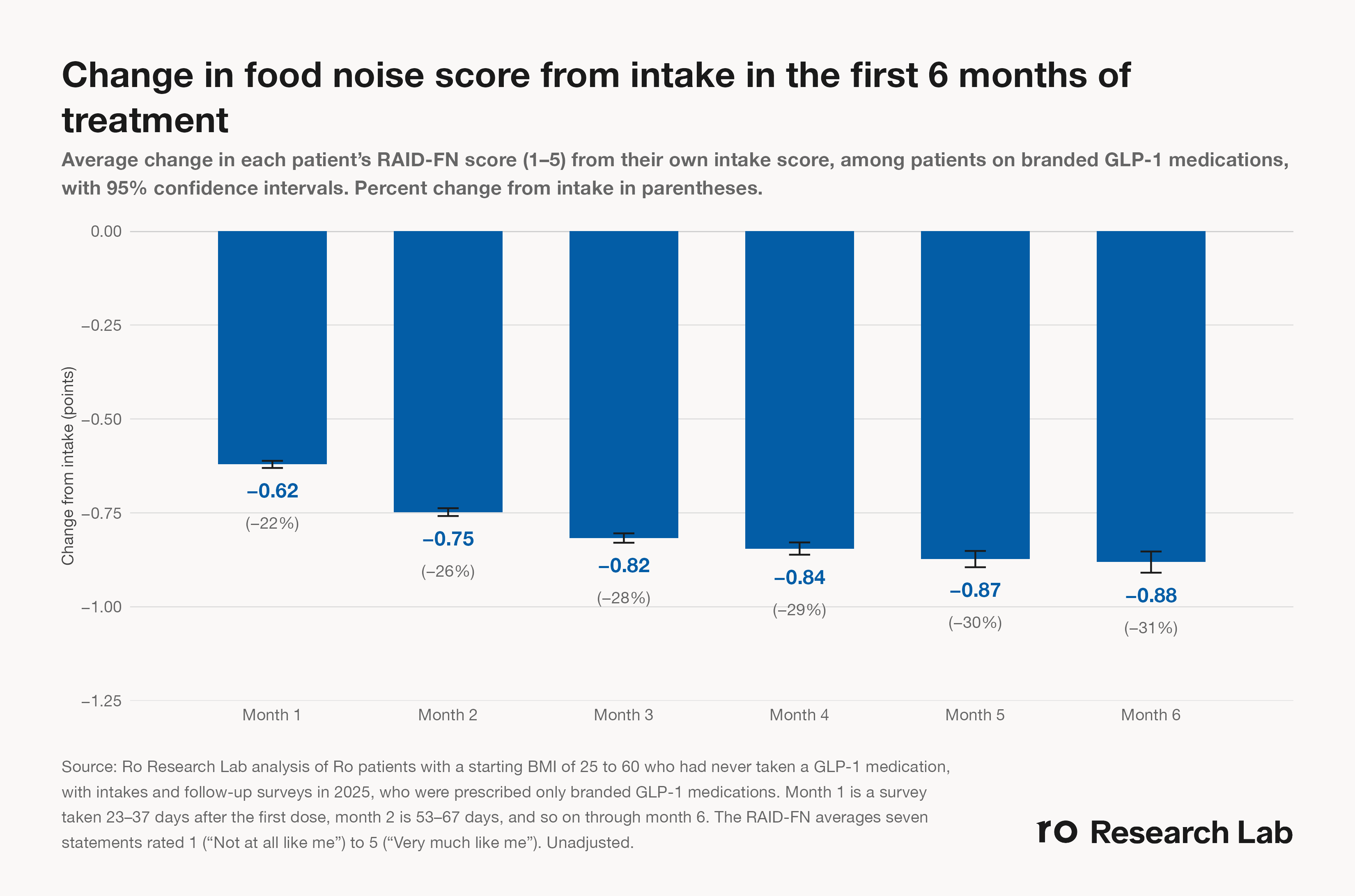
Need more proof? Take a look at the following chart: By month 1, patients’ average RAID-FN (food noise) score decreased by 22% and continued to decline after that.
Losing weight, gaining control
Less food noise, which also means less self-criticism, and both are happening within the first few months of GLP-1 treatment.
But why might feeling less consumed by thoughts of food also mean feeling less critical of yourself?
That’s a question worth exploring in future research. For now, here’s one theory to chew on: control.
When thoughts about food feel constant and impossible to shut off, it’s easy for frustration with that mental chatter to turn into frustration with — or even hatred for — yourself. After all, 50.4% of patients initially “somewhat” agreed with the statement, “I hate myself for not being able to control my thoughts about food.”
But when GLP-1s help turn down the volume, patients may finally feel more in control — and less inclined to blame themselves or feel ashamed for what once felt like a losing battle with food noise.
That sense of control is part of a psychological phenomenon called “perceived control.”
Research suggests that feeling more in control can buffer psychological stress. And with less stress surrounding something that once felt unmanageable, patients may be less likely to internalize that struggle as a personal failure. Such a shift in perspective could help ease their food noise-spurred self-hatred.
That being said, again, control may just be one piece of the puzzle. There could be other explanations for how these different dimensions of food noise improve together. Here’s hoping we can explore that through future research.
Methods
We looked at RAID-FN responses among Ro patients with a BMI of 25 to 60 who had never taken a GLP-1 medication before and started a branded GLP-1 medication in 2025. We looked at the share of patients who answered at least “somewhat like me” to two statements: “I hate that I always have food on my mind” and “I hate myself for not being able to control my thoughts about food.”
Each statement is rated from 1 (“Not at all like me”) to 5 (“Very much like me”). We compared responses at intake, before starting treatment, with responses to follow-up surveys taken about once a month for the first six months after the first dose.
This analysis has some limitations. Patients complete the RAID-FN when they request a refill, so later months only include patients who stayed on treatment. We did not adjust for other patient characteristics, such as age, sex, or dose, that could help explain how responses changed over time.
References
- 1.Fielder, J. C., Shi, J., McGlade, D., Huys, Q. J. M., & Steinbeis, N. (2026). Sense of control buffers against stress. eLife, 14, RP105025. doi:10.7554/eLife.105025. Retrieved from https://elifesciences.org/reviewed-preprints/105025
- 2.Trocchio, L. L., & Peters, F. (2025). Taking back control: The experience of adults using semaglutide and tirzepatide for obesity treatment - A qualitative study. Obesity Pillars, 17, 100237. doi:10.1016/j.obpill.2025.100237. Retrieved from https://pmc.ncbi.nlm.nih.gov/articles/PMC12702257/